Retrofit vs new machine: the decision that burns the most money (and gets analysed the least)

In plastics recycling I hear one sentence far too often: “the line works, we just need to upgrade it a bit.” And I also hear the opposite: “let’s scrap it and buy new.” Both can be expensive mistakes. The controversial part is that many decisions are made by gut feeling, fear of stopping production, or falling in love with a brand—when in reality this is about risk, quality window, and true cost per saleable tonne.

The right question is not “how much does the retrofit cost?” but “what does that retrofit actually buy me?” If the market pays for a more consistent material and you are losing tonnes through downtime, rejects, or claims, a retrofit can be the best investment of the year. But if the mechanical foundation is exhausted, a retrofit becomes make-up: you spend €200–400k only to discover the real limitation was structural (geometry, drying capacity, lack of residence time, vibrations, no real process control) and you still can’t sell into the segment you want.
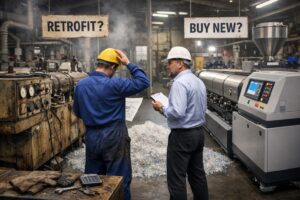
For me, retrofitting makes sense when the machine still has a solid “body”: strong structure, correct geometries, and reasonable capacity—but it is missing the elements that make the difference today. On an extruder, for example, adding real degassing (vacuum system, proper venting, sealing), improving filtration, and tightening temperature control can completely change odor, stability, and customer complaints. In washing, properly upgrading fines removal, managing temperature windows, and improving drying to hit real setpoints can increase saleable output without touching the layout. In those cases, a retrofit is not a patch—it closes the gap between “I can produce” and “I can sell well.”

Now the uncomfortable part: some retrofits are self-deception. When the machine cannot meet requirements by design, no new PLC will fix it. If your washer doesn’t have enough residence time, if drying is undersized, if hydraulics force you to mix incompatible streams, or if pneumatic conveying is fundamentally wrong, what you are buying with the retrofit is time… until the next crisis. Same when the line needs a “hero operator” to survive: as soon as that person is not there, the chaos returns. In those cases, buying new is often cheaper than continuing to pay the hidden cost of low quality, yield loss, and downtime.

I usually frame it with a simple rule: if the retrofit lets you enter a market you cannot reach today (odor, consistency, contamination, moisture, fines), then it’s a strategic investment. If it only allows you to “suffer a little less” while making the same material as always, you are usually postponing an inevitable purchase. And the money you think you save leaks out through the side nobody puts in the spreadsheet: unsaleable tonnes, price discounts due to variability, customer claims, overtime, and energy from operating outside the right window.

The decision becomes much clearer when you force the numbers to speak per saleable tonne and per risk. What does each unplanned stop really cost you? How much margin do you lose by selling into low-spec markets because you can’t reach high-spec? What does quality instability cost you in discounts or returns? If a retrofit reduces those losses and gives you a 12–24 month payback, go for it. If the payback only works on paper while ignoring claims and variability, and you need everything to run perfectly for it to make sense, buy new—or redesign the foundation.

I’ll finish with a provocation: many plants keep retrofitting to avoid the hard decision. And many others buy new to avoid thinking. In 2026, with higher requirements and tighter margins, the smart move is neither “retrofit” nor “new CAPEX for ego.” The smart move is to invest only when it translates into saleable quality, operational stability, and a total cost per tonne you can defend to any auditor—or any CFO.

For debate: what has worked better in your plant—a well-focused retrofit or a new line—and what was the decisive variable (quality, energy, downtime, OPEX, maintenance, people)?

Consulting Services in Recycling

Starting Up a New Plant or Modifying Your Existing Facility

Are you considering the installation of a Polyethylene recycling plant or looking to enhance your existing facility? EcoPlast Consulting is here to guide you. With our extensive knowledge of the sector and a trustworthy approach, we act as your vigilant partner. We oversee your investments to ensure you purchase exactly what you need at the best price, always with an eye toward maximizing your efficiency and profitability. Trust us to safeguard your interests every step of the way.

Advanced Recycling Processes and Technology Solutions

Product Design for Recyclability

In today’s sustainability-focused market, the recyclability of a product is as crucial as its functionality. At EcoPlast Consulting, we guide you through the design process to ensure your products are not only efficient but also fully recyclable. We provide expert advice on how different components can enhance or impede the recycling process, helping you make informed decisions that align with best practices in environmental sustainability.

Waste Technology and Recycling Facilities

Support with funding applications for recycling and resource efficiency projects

Securing funding for recycling and resource efficiency projects is critical for advancing your sustainability goals.
At EcoPlast Consulting, we specialize in assisting clients with the preparation and submission of funding applications. Our expertise ensures that your proposals are well-crafted, highlighting the environmental and economic benefits of your projects to maximize the likelihood of approval.
Additionally, we will act with the utmost discretion to help you find the best buyer or funding body for your projects. Let us help you navigate the complexities of funding applications to successfully secure the financial support you need for your initiatives.

Audits of Waste Supply Chains

Audits of Waste Supply Chains and Recycling Operations (Qualitative and Quantitative Evaluation)

EcoPlast Consulting provides detailed audits of your waste supply chains and recycling operations to ensure both consistency and quality. We offer evaluations of potential suppliers, including on-site visits when authorized, and thorough analyses of supply sources, processes, and quality controls. Our approach gives you the assurance of knowing exactly what you are purchasing and ensures that you receive consistent quality over time. Trust us to maintain integrity and transparency throughout your supply chain.

Funding Applications for Recycling Projects

Comprehensive Due Diligence and M&A Consulting for the Plastics Industry

EcoPlast Consulting provides in-depth technical due diligence and strategic M&A consulting services, specifically tailored for the dynamic plastics sector. Our evaluations focus on the condition, efficiency, and capacity of machinery, alongside a review of production reports from your operations, ensuring you make well-informed investment and acquisition decisions.
In the rapidly evolving recycling and plastics processing industries, understanding the physical wear and technological advancements of machinery is critical. Our detailed assessments help you grasp the full scope of your potential investments, avoiding costly mistakes and ensuring your investments are future-proof. Additionally, we offer post-acquisition consulting to strategic buyers, middle-market private equity firms, family offices, and financial institutions within the plastics industry. We excel at identifying risks and uncovering opportunities that achieve operational synergies, maximize exit valuations, and enhance returns on investment.
Trust EcoPlast Consulting to provide the expertise needed for your next venture, helping you navigate complex transactions with customized, comprehensive solutions.

Product Design for Recyclability

Advanced Recycling Processes and Technology Solutions

At EcoPlast Consulting, we assist in enhancing your recycling processes with cutting-edge technical solutions that prioritize product quality, cost-effectiveness, and space efficiency. We design systems to minimize the spatial footprint at your facilities while maximizing operational efficiency. Our approach ensures that the investments you make in recycling technology not only meet but exceed environmental and economic goals.

Starting Up a New Recycling Plant

Assessment and development of waste technology and recycling facilities

At EcoPlast Consulting, we specialize in evaluating your current waste management and recycling technologies to determine if they meet the latest standards of efficiency and innovation. We conduct thorough cost-benefit analyses to ensure that upgrades lead to rapid returns on investment. Our expert guidance helps you identify and implement cutting-edge developments, positioning your operations at the forefront of technology and product quality. Trust us to elevate your facilities to industry benchmarks.

Consulting Services in Recycling

Expert Management Advisory and Strategic Business Growth Initiatives

At EcoPlast Consulting, we specialize in providing hands-on support to a broad range of businesses outside the waste sector, including retailers and supermarkets, helping them reduce waste management costs and maximize resource efficiency. Leveraging our extensive industry network, we develop customized waste management strategies tailored to the specific needs of each business. Our independence from waste management companies and equipment suppliers ensures that our clients receive unbiased, comprehensive guidance designed to deliver measurable results.