In my last article, I discussed the ambitious goals set by the new Packaging and Packaging Waste Regulation (#PPWR). Today, I want to go one step further—into the real world, into the sorting lines of a plastic recycling plant.
Because it’s one thing to write a regulation, and quite another to implement it with industrial logic.
The Case of HDPE Bottles
Let’s take for example high-density polyethylene (HDPE) bottles as an example. Any recycler who wants to become a reference in the market today must have a color separation unit, often integrated into their facility.
Let’s say a recurring supplier sends material with this approximate breakdown of colors:
- 20% natural transparent
- 25% white
- 15% multilayer
- 12% blue
- 12% yellow
- 6% red
- 5% green
- 5% pink
Now imagine a truck arrives with 20 tons of mixed material. (Normally is less) Even if we assume (unrealistically) that there’s zero loss, the output after sorting would yield only:
- 4 tons of white
- 3 tons of multilayer
- and just 1 ton of pink, and so on on the rest of the colors.
So, to get enough pink HDPE for example, to make a consistent 25-ton lot, we will need 25 full trucks of bales, which means this would happen over several weeks, with constant warehouse movements, broken bales, forklift damage, and shifts in stock.
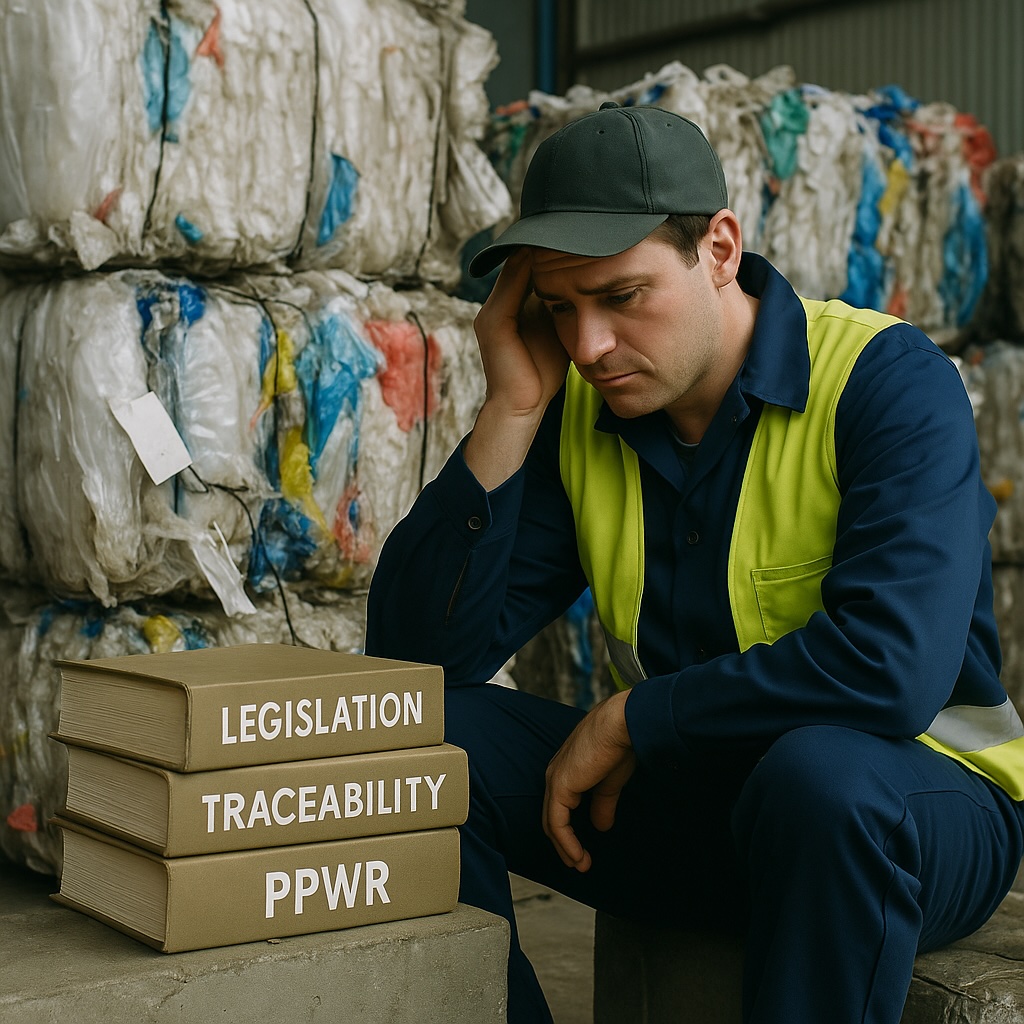
So here’s the uncomfortable question: Can we really guarantee complete traceability of each output batch to a specific input batch? Even more, can we trace that pink bale back to which of the 25 truckloads it came from?
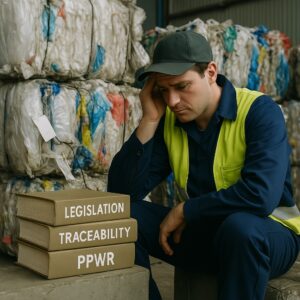
Traceability vs Trust
That’s why I have always said: Perfect traceability doesn’t exist. Not in a real-world plastic recycling plant, where every day brings new challenges, and where material flow is rarely linear.
What does exist—and what truly matters—is trust. Trust built on solid procedures, operational discipline, and a commitment to transparency even when things go wrong.
A good recycler is not the one who promises the impossible. It’s the one who:
- Documents every stage of the process with consistency,
- Monitors material flows with common sense and pragmatism,
- Communicates openly with clients (especially when things don’t go as planned), and
- Takes responsibility—without excuses—when there’s an issue with quality, contamination, or delivery.
- and generates consistent quality over time.
In short, a recycler who behaves like a partner, not just a supplier.
Because no matter how sophisticated your Excel file or ERP system may be, in the end, it’s people who make recycling work. And that trust, once earned, is worth more than a spreadsheet with twelve tabs and perfect formulas.
Final Situation
Yes, the PPWR demands traceability, and don’t take me wrong, we need it as water, but it also requires technical realism and a clear understanding of how a recycling plant actually works, and those writing the PPWR have been very little time in a recycling plant.
Otherwise, we risk turning regulation into a barrier that drives out experienced recyclers who lack full digitalization, and that, honestly, would be a strategic mistake for Europe.
Because every additional layer of documentation, sensors, audits, and software meant to “prove” traceability has a cost—a cost that suffocates recyclers unless it’s matched with higher prices for recycled materials.
We cannot demand excellence in compliance and expect to pay commodity prices.
Real traceability isn’t free, and neither is quality.