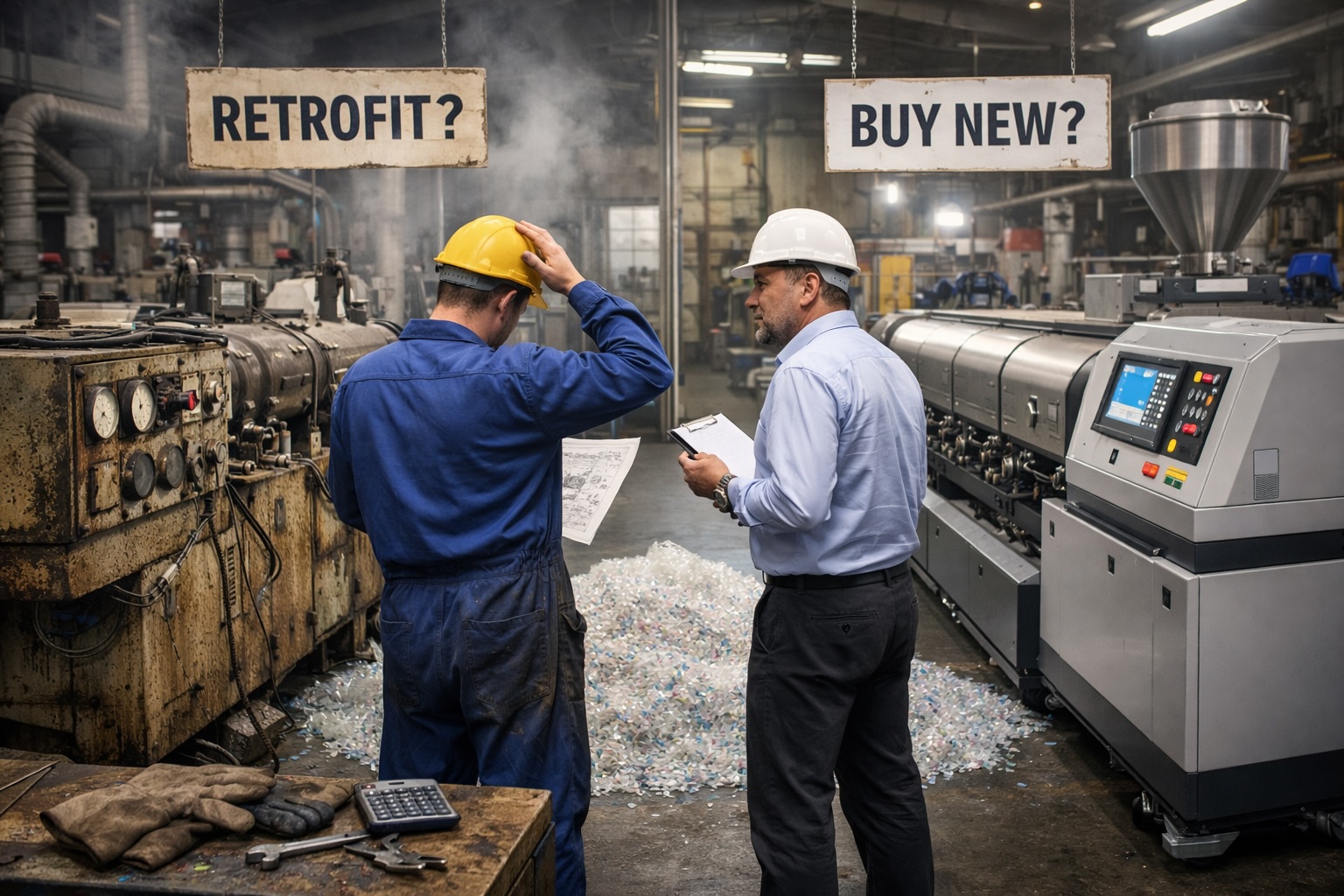
In plastics recycling I hear one sentence far too often: “the line works, we just need to upgrade it a bit.” And I also hear the opposite: “let’s scrap it and buy new.” Both can be expensive mistakes. The controversial part is that many decisions are made by gut feeling, fear of stopping production, or falling in love with a brand—when in reality this is about risk, quality window, and true cost per saleable tonne.
The right question is not “how much does the retrofit cost?” but “what does that retrofit actually buy me?” If the market pays for a more consistent material and you are losing tonnes through downtime, rejects, or claims, a retrofit can be the best investment of the year. But if the mechanical foundation is exhausted, a retrofit becomes make-up: you spend €200–400k only to discover the real limitation was structural (geometry, drying capacity, lack of residence time, vibrations, no real process control) and you still can’t sell into the segment you want.
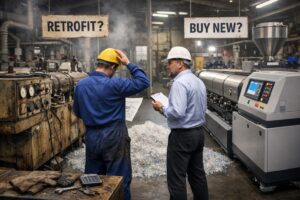 For me, retrofitting makes sense when the machine still has a solid “body”: strong structure, correct geometries, and reasonable capacity—but it is missing the elements that make the difference today. On an extruder, for example, adding real degassing (vacuum system, proper venting, sealing), improving filtration, and tightening temperature control can completely change odor, stability, and customer complaints. In washing, properly upgrading fines removal, managing temperature windows, and improving drying to hit real setpoints can increase saleable output without touching the layout. In those cases, a retrofit is not a patch—it closes the gap between “I can produce” and “I can sell well.”
Now the uncomfortable part: some retrofits are self-deception. When the machine cannot meet requirements by design, no new PLC will fix it. If your washer doesn’t have enough residence time, if drying is undersized, if hydraulics force you to mix incompatible streams, or if pneumatic conveying is fundamentally wrong, what you are buying with the retrofit is time… until the next crisis. Same when the line needs a “hero operator” to survive: as soon as that person is not there, the chaos returns. In those cases, buying new is often cheaper than continuing to pay the hidden cost of low quality, yield loss, and downtime.
I usually frame it with a simple rule: if the retrofit lets you enter a market you cannot reach today (odor, consistency, contamination, moisture, fines), then it’s a strategic investment. If it only allows you to “suffer a little less” while making the same material as always, you are usually postponing an inevitable purchase. And the money you think you save leaks out through the side nobody puts in the spreadsheet: unsaleable tonnes, price discounts due to variability, customer claims, overtime, and energy from operating outside the right window.
The decision becomes much clearer when you force the numbers to speak per saleable tonne and per risk. What does each unplanned stop really cost you? How much margin do you lose by selling into low-spec markets because you can’t reach high-spec? What does quality instability cost you in discounts or returns? If a retrofit reduces those losses and gives you a 12–24 month payback, go for it. If the payback only works on paper while ignoring claims and variability, and you need everything to run perfectly for it to make sense, buy new—or redesign the foundation.
I’ll finish with a provocation: many plants keep retrofitting to avoid the hard decision. And many others buy new to avoid thinking. In 2026, with higher requirements and tighter margins, the smart move is neither “retrofit” nor “new CAPEX for ego.” The smart move is to invest only when it translates into saleable quality, operational stability, and a total cost per tonne you can defend to any auditor—or any CFO.
For debate: what has worked better in your plant—a well-focused retrofit or a new line—and what was the decisive variable (quality, energy, downtime, OPEX, maintenance, people)?