People sometimes talk about recyclers as if they were the last link in the trash chain (until they need them to accomplish legislation)
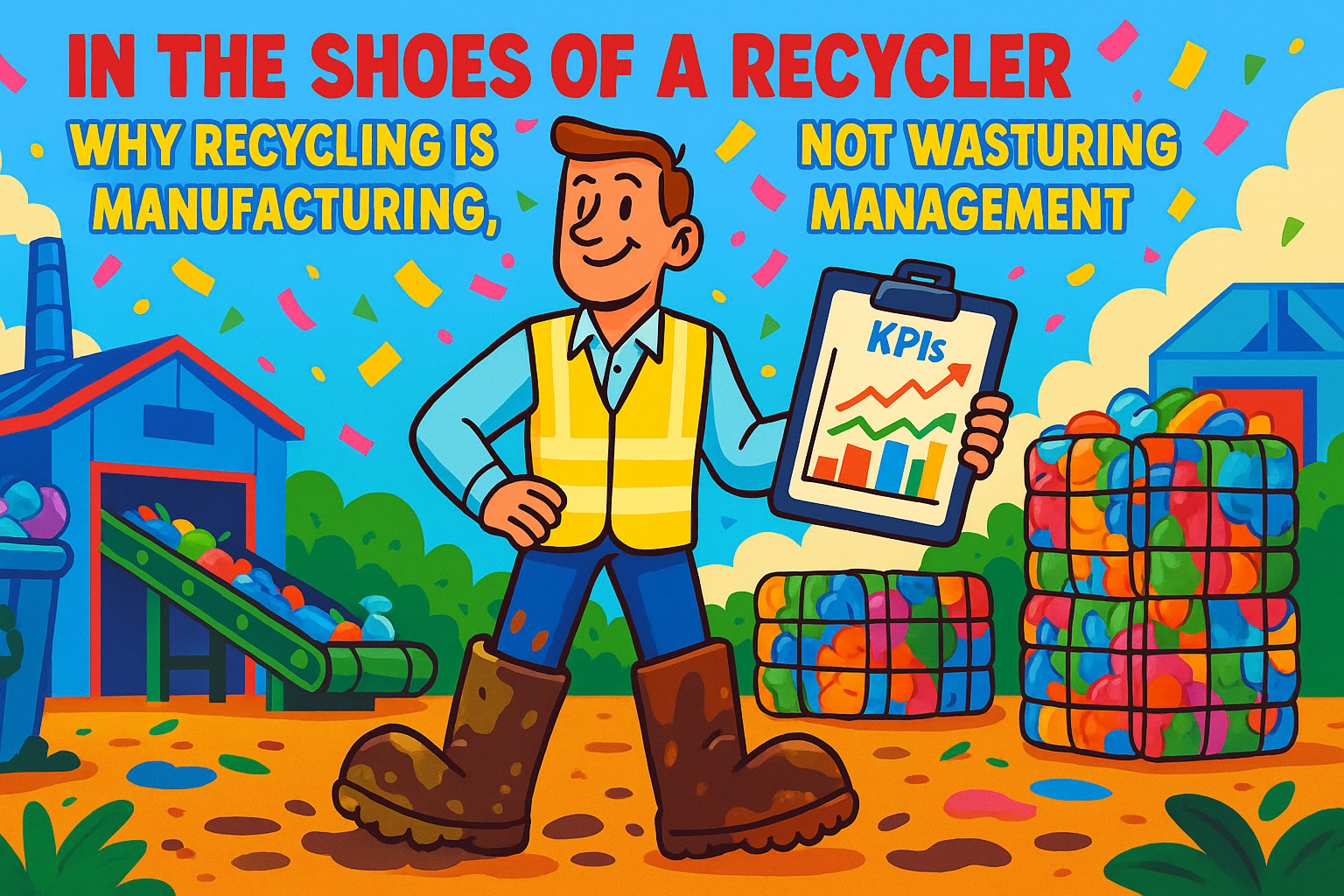
However, a modern recycling plant looks far more like a factory than a landfill: there are processes, standards, KPIs, audits, maintenance plans… and customers who demand consistent quality.
What “manufacturing” means in recycling
Manufacturing, in this context, is turning variable inputs (waste) into products with specifications(pellet/granulate) in a stable and repeatable way. It’s not “making trash disappear”; it’s industrializing: designing processes, controlling variability, documenting batches, and delivering conforming product… again and again constant quality with un-constant supply.
From waste to pellet: what the movie really is
1)Receiving and sampling: A truck doesn’t bring “waste”: it brings uncertain raw material, It’s weighed, photographed, sampled, assigned a lot ID, and pre-characterizednbsp;(color, moisture, contaminants, waste). That first snapshot sets the tone for everything that follows.
2) Pre-sorting and preparation: Non-conformity materials (metals, textiles, wood…) are removed; streams are separated by families or colors when applicable (critical in HDPE). Goal: homogenize flows so extrusion isn’t a roller coaster, we need maximum stability.
3) Grinding: Material is reduced to flake with controlled size. The more uniform it is, the better the washing and melting.
4) Washing: Friction, cold/hot baths, detergents, and float/sink to separate polymers by density. Most organics, glues, and grit leave here. This is also where many hidden costs are born and where recyclers make the difference.
5) Drying: Centrifuges and sometimes hot air, bring moisture down to safe levels. If water reaches extrusion, pellets go back to the start line.
6) Extrusion and filtration: Flake melts; it’s filtered (screens), degassed (high vacuum), and pelletized.Thermal profiles and throughputs are tuned and, if the specification requires it, masterbatch is added. It’s a balanced procedure.
7) Deodorization (the new frontier): More and more customers ask: “cheap pellets with no smell.” Reality: removing odor has a cost.
- What’s applied: deep degassing (multiple high-vacuum vents), hot stripping (silos with counter-current air/steam), and absortion or on activated carbon system.
- What it removes: volatiles, residues of perfumes/detergents, aldehydes, short-chain compounds.
- How it’s verified: organoleptic panels, chromatography when needed, and “hot-part” tests at the customer. Good “noses” at the customers laboratory
- Consequence: more energy, CAPEX/OPEX, and some yield loss. If the market wants near-zero odor, it needs to PAY for that engineering.
8) Homogenization and quality control Buffer silos smooth variations A certificate of conformity is issued with a traceability trail.
Realistic traceability (with boots on the shop floor)
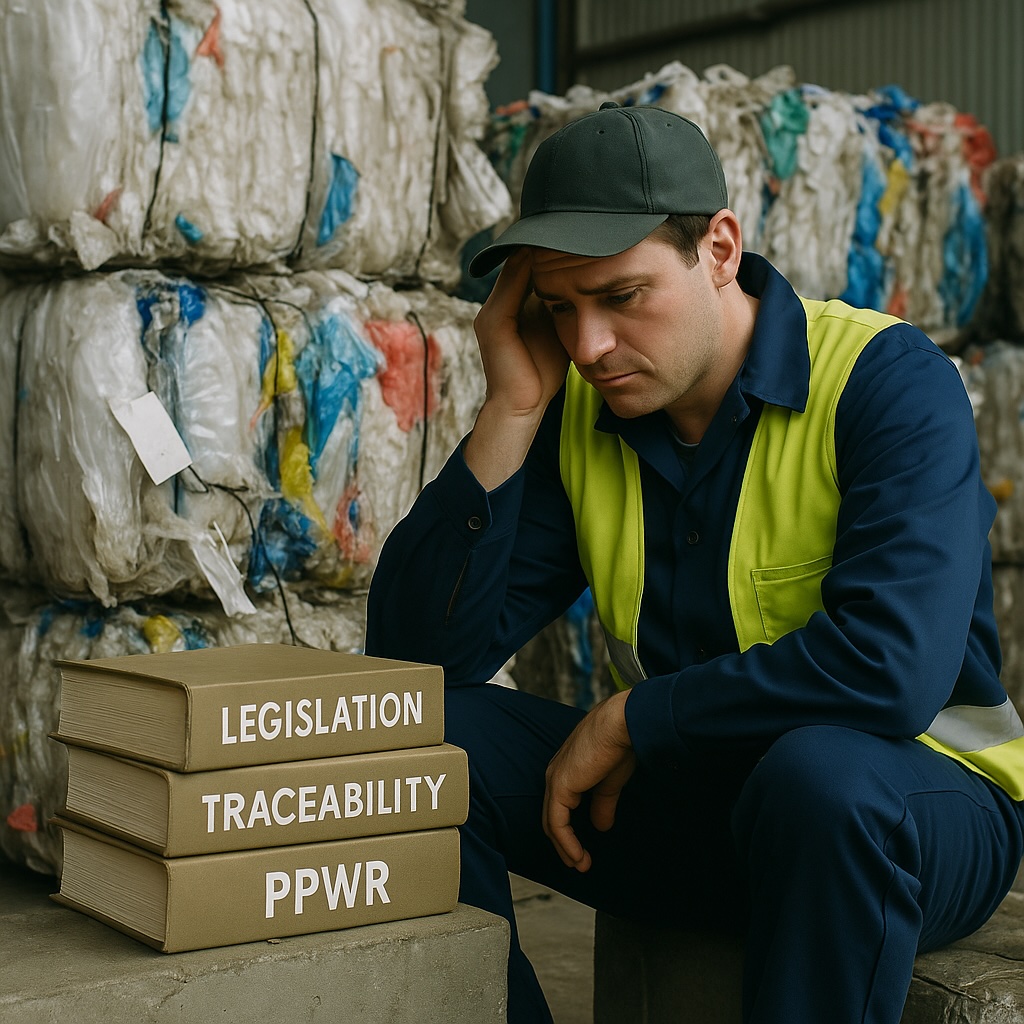
Traceability isn’t a pretty spreadsheet; it’s operational discipline and only may be achieve if the plant is managed as an industry and not just a yard.
- Useful digitalization: connected weighbridge, barcodes/QR per bale, line- and hour-level consumption of products (water), and a control system in the PLC that records mixes, splits, and merges (which silo received which lots, in which shift, with which operator).
- The real flow map: one truck can feed three lines; one silo can mix five sources; and an incident can originate from a saturated screen, not from the “wrong truck.”
- Honest expectation: 100% perfect traceability is a mirage when you have color separation, broken bales, reworks, and intake spikes. The professional target is sufficient traceability to investigate, correct, and prevent recurrence.
The hidden costs (and why “cheap and odorless” doesn’t exist)
- Energy and water (hot washing, drying, deodorizing).
- Chemicals and effluent treatment (detergents, antifoams, wastewater treatment).
- Consumables (screens, filters, activated carbon) and yield losses.
- Maintenance (screws, vacuum pumps, knives, gearboxes).
- Lab and metrology (equipment, calibrations, staff).
- Audits and certifications (EuCertPlast, RecyClass, ISO 9001/14001).
- Software and data (MES/ERP, histories, cybersecurity).
- Insurance, PPE, training, and plant safety.
None of that is visible in the pellet… but it lives inside its price. Asking for “waste pricing” on a pellet that behaves like virgin underestimates this industrial effort reality.
…….. and what happens when something goes wrong
The alert A customer calls: “The caps smell odd, like perfume.” We don’t argue the symptom; we take it seriously. First we make things safe: block shipments and place linked lots in quarantine. No rushing, but not wasting a minute.
- With shipments stopped, we ensure nothing else leaves without an additional control. Pallets are tagged, planning is informed, and the incident protocol has started.
- Check the obvious and measure the critical at the laboratory: MFI, moisture, density, and ash. All within spec… but the organoleptic panel confirms the clue: there’s a perfume note. When hard data is quiet and noses speak up, we go deeper.
- Dive into detail (volatile compounds) Chromatography: peaks compatible with household fragrances. Not an extrusion failure; it’s a feedstock profile. We’re no longer looking for a generic “error,” but for where it came from.(Traceability)
- Real traceability lookup: which bales came in which shift, which silos mixed them, which line pelletized them. A pattern emerges: that day had higher input from home-care containers (but this is difficult to check as we depend on operators motivation and knowledge to point it out). The “strong odor” matches the operations: the raw material carried fragrance.
- Find the root cause: The input arrived “loaded,” and our setup was tuned for normal volatiles, we did not split the batch. Result: insufficient degassing capacity for that profile + deodorization process close to saturation with parameters that should be changed. Not a “silly mistake,” but a combination of input + setpoints.
- Fix without patches — and validate: We adjust vacuum and residence time, raise the deodorization threshold for perfumed streams, and revise the mixing formula. We reproduce the lot under the new conditions and repeat sensory and analytical checks. This time, APPROUVED.
- Communicate like manufacturers: We inform the customer with facts: what happened, how we detected it, what we changed, and how it was verified. We align on re-validation with their tests and set an extra control point for the coming weeks. Transparency and method: that’s how trust is rebuilt.
- Learn it — and write it down This incident closes with lessons learned in the system:
- Reinforce deodorization when the “home-care” input rises.
- Mixing matrix review with limits for odor-heavy profiles.
The goal isn’t to promise “it will never happen again,” but to ensure that if it reappears, we detect it earlier and solve it better, before it leaves the plant.
When recyclers are treated as manufacturers, everything improves
- Clear specification (properties and tolerances, not wishes).
- Agreed control plan (what, how, who, how often).
- Change management (pilot tests, approval, scale-up).
- Realistic forecasts and supply windows (avoid impossible peaks).
- Price aligned with what’s requested (high PCR, deodorization, traceability, stability).
And here comes my conclusion and question for you:
Recycling is not “making waste disappear.” It is manufacturing process: turning variable inputs into products with specification under testing, audits, and customers who don’t forgive mistakes.
If the market wants stable, low-odor pellets, it must understand — and pay for it — what it costs to make them.
If you had to pick ONE KPI to evaluate a recycler as a true manufacturer, which would you put first and why?